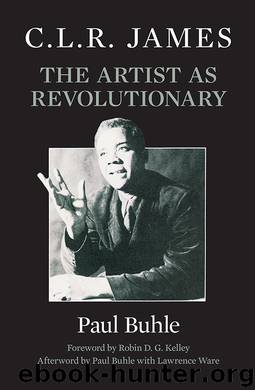
C. L. R. James by Paul Buhle
Author:Paul Buhle
Language: eng
Format: epub
Publisher: Verso Books
‘Johnsonism’ Winds Down
The trajectory of his collective political work continued the unintended substitution of the aesthetic for the political, until the end of the little Johnson-Forest movement had been reached. Without James on hand (fervent and directive as his letters continued to be for a decade or more), Johnsonism drifted on an uncertain course, sometimes striking out in genuinely new directions, sometimes falling back upon the basic syndicalism of the Trotskyist factory group. Their paper, Correspondence, at first a weekly, then semi-monthly and still later a monthly tabloid, sought to straddle these realities and to offer readers their own forum on passing events of the day. It certainly attempted the old message of factory-centred struggle. But as editorial board member Grace Boggs recalls, only a certain type of worker responded. The angry auto worker who spoke through the paper (usually via an amaneusis, in the style James developed in Missouri) was extremely likely to be a Black man who had come into the factory without the full benefits from or nostalgia for the early years of unionism.
When resentment turned into wildcat strikes, Correspondence presciently recognized the importance of the struggle. Indeed, the Johnsonites probably recognized and interpreted the importance of the wildcat before any other element of the American Left. Likewise at the level of daily life, Correspondence captured the working-class response to I Love Lucy or to the World Series better than anyone else on the Left. This accomplishment could be described almost as the mirror opposite of the aesthete, increasingly conservative Partisan Review, which had all the national prestige Correspondence lacked. (To continue the contrast: members of the Partisan Review editorial group signed on with the CIA-linked American Committee for Cultural Freedom, while the Johnsonites took the rap of being officially listed as a subversive organization. This writer, facing the army induction process, compulsively noted his literary appearance in still-proscribed ‘Johnsonite’ publications. The Army awarded him a reprieve from Vietnam.) But perhaps it is better to see Correspondence, by this time, as essentially a gaze at the hidden worlds of Detroit’s boom years.33
James and his fellow leaders affixed upon this journalism a rather mechanical political structure and an increasingly doubtful teleology. He was to say later that the group knew what it did not want – another version of Vanguardism – but it could not develop what it wanted instead. The very title had come from a 1920s Comintern experiment, ‘Correspondence’, intended to mobilize worker-writers from the depths of proletarian life. The experience had not been particularly successful at the time, and faced the same problems thirty years later. Lenin’s 1920 distinction of three Bolshevik layers – old Bolsheviks at the first layer, trade unionists at the second layer and the rank-and-file at the third layer – now became the source of an effort in public meetings to subject first and second to the expostulations of the third. At such an apolitical moment as the early 1950s the result increasingly tended toward the rambling and diffuse. Other complaints could also be heard, centring on styles of leadership.
Download
This site does not store any files on its server. We only index and link to content provided by other sites. Please contact the content providers to delete copyright contents if any and email us, we'll remove relevant links or contents immediately.
| Anthropology | Archaeology |
| Philosophy | Politics & Government |
| Social Sciences | Sociology |
| Women's Studies |
The Secret History by Donna Tartt(19097)
The Social Justice Warrior Handbook by Lisa De Pasquale(12194)
Thirteen Reasons Why by Jay Asher(8915)
This Is How You Lose Her by Junot Diaz(6891)
Weapons of Math Destruction by Cathy O'Neil(6283)
Zero to One by Peter Thiel(5805)
Beartown by Fredrik Backman(5763)
The Myth of the Strong Leader by Archie Brown(5511)
The Fire Next Time by James Baldwin(5452)
How Democracies Die by Steven Levitsky & Daniel Ziblatt(5221)
Promise Me, Dad by Joe Biden(5155)
Stone's Rules by Roger Stone(5089)
A Higher Loyalty: Truth, Lies, and Leadership by James Comey(4965)
100 Deadly Skills by Clint Emerson(4929)
Rise and Kill First by Ronen Bergman(4793)
Secrecy World by Jake Bernstein(4755)
The David Icke Guide to the Global Conspiracy (and how to end it) by David Icke(4721)
The Farm by Tom Rob Smith(4516)
The Doomsday Machine by Daniel Ellsberg(4492)
